Zero-click search is a search session that ends without a click to any website, because the answer appears on the results page or in an AI response. This article explains why AI Overviews and AI assistants are driving the shift, how AI visibility differs from traditional SEO, and where B2B brands should focus next.
Key takeaways
- Zero-click search ends without a visit to any website, and Semrush found 93% of Google AI Mode searches end this way.
- Google reported AI Mode at one billion monthly users and AI Overviews at over 2.5 billion, so ranking position and actual visibility have separated.
- AI-referred visitors convert at 14.2% compared with 2.8% from traditional Google search, because they arrive already at the evaluation stage.
- AI-driven discovery is hard to track, as buyers often meet a brand in an AI answer weeks before a branded search shows up in analytics.
Something has changed in how customers find the brands they end up working with. The signals are subtle: a plateau in organic traffic, a rise in direct or unattributed sessions, buyers arriving at conversations already familiar with your positioning without any clear referral source to explain it.
The cause is structural. Gartner predicted that traditional search engine volume would fall 25% by 2026 as AI chatbots and virtual agents became substitute answer engines. That prediction is now playing out in real traffic data. Buyers are getting answers without clicking. They’re asking AI assistants which platform to evaluate, prompting answer engines to compare vendors, and letting Google synthesise their options before they visit a single website.
The case here is for understanding a new discovery layer, one that sits above and alongside traditional search rankings and responds to different signals. Because AI may introduce your brand, but people still decide whether to trust it.
Why we’re entering a zero-click era
Zero-click search describes a search session that ends without the user clicking through to any external website. The answer is served within the results page, or the AI response itself, and the session closes.
The data is striking. Semrush found that 93% of searches through Google’s AI Mode end without a click, and 83% of queries that trigger AI Overviews do the same. In both cases, users receive their answer before any external website is visited. Even in traditional Google Search, the majority of queries now end without a click.
What this means in practice is that visibility has shifted upstream. The moment decisions begin forming is increasingly happening inside an AI-generated answer, before a user has clicked on anything.
Google is becoming an answer engine too
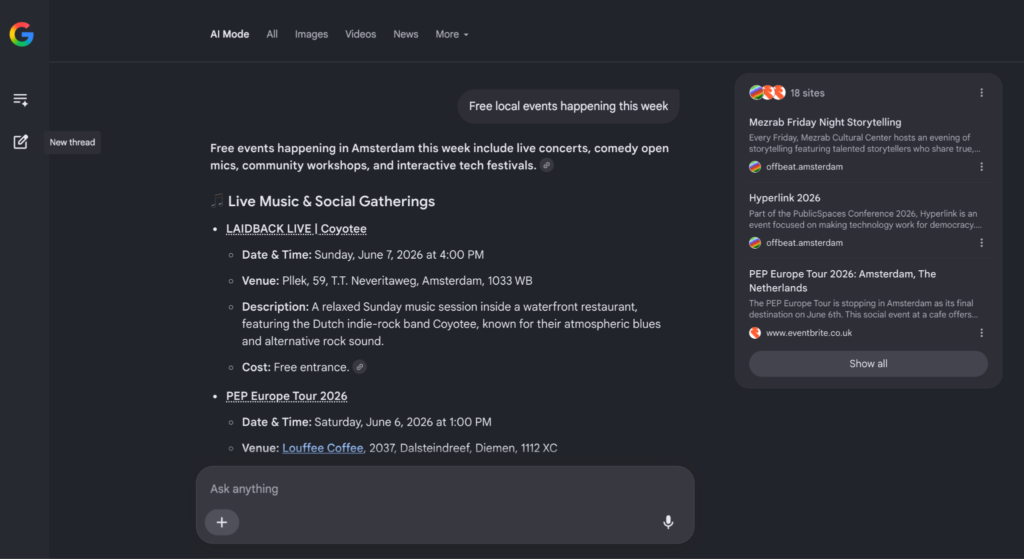
Google’s direction here has been consistent for years: featured snippets, knowledge panels, direct answers. But the pace has changed significantly. At Google I/O in May 2026, the company confirmed that AI Mode had reached one billion monthly active users, while AI Overviews had surpassed 2.5 billion. Earlier in 2026, Google disclosed that AI Overviews were appearing on roughly 50% of tracked queries.
Google also confirmed at I/O that AI Mode and AI Overviews are being merged into a single AI search experience with continuous conversational follow-up. The top of the results page has become a synthesis layer that reads, evaluates, and presents answers drawn from sources across the web.
The practical implication for businesses is this: a brand can hold a top-three position on a competitive keyword and still be absent from the AI summary that most users now read first. Ranking position and actual visibility are no longer the same measure.
How AI is reshaping digital discovery
Google is the most visible dimension of this shift, but the picture is broader. ChatGPT Search, Perplexity, and Gemini are functioning as parallel discovery channels for a growing share of buyers, particularly in B2B. People are no longer only searching; they’re asking, comparing, and forming views through conversational interfaces before engaging with any brand directly.
For many B2B teams, this creates a real measurement gap. A buyer may have encountered your brand in an AI-generated response, then seen it referenced in a publication, then heard it mentioned by a peer, all before appearing in your analytics through a branded search weeks later. AI-driven discovery is harder to track and easy to underestimate as a result.
This also adds another layer to what is already a non-linear buyer journey. The AI touchpoint arrives earlier in the decision process than traditional channels would have captured, which means brands need to be present and credible in those channels long before a buyer signals any visible intent.
Why human trust matters more than ever
The zero-click era sharpens the role of trust rather than diminishing it. Buyers arriving via an AI citation have already been introduced to your brand by a synthesised answer; they arrive ready to evaluate, which means credibility questions surface sooner.
AI-referred visitors convert at 14.2%, compared to 2.8% for traditional Google search. The difference reflects intent: much of the awareness work has already happened, and these visitors arrive at the evaluation stage from the start. The scrutiny comes earlier and moves faster.
In B2B, this is particularly significant. An AI summary handles awareness and shortlisting effectively. The depth of trust that a high-value, multi-stakeholder decision requires still depends on genuine authority, published expertise, and reputation built over time. Those remain the variables that move someone from awareness to commitment.
For B2B organisations, this is an argument for investing seriously in the depth and breadth of published thinking: detailed perspectives, credible external mentions, and the kind of consistent expertise that earns recognition across multiple surfaces rather than within a single channel.
SEO vs AI visibility: what’s actually changing?
Traditional SEO and AI visibility are related disciplines, but they respond to different signals and reward different things. Understanding the distinction matters more than treating one as a replacement for the other.
| Factor | Traditional SEO | AI visibility |
| Goal | Rank in a list of links | Be cited in a synthesised answer |
| Success metric | Traffic, CTR, position | Citation frequency, brand representation |
| Key signal | Backlinks, keyword relevance | Authority, factual density, entity trust |
| Source competition | 10 results per query | 2–7 citations per answer |
| Traffic model | Click-based | Often zero-click; higher intent on arrival |
Traditional SEO responds to relevance and link authority. AI citation responds to depth, accuracy, and the consistency of expertise across multiple sources and channels. We’ve covered the tactical mechanics of this in detail in our LLM optimisation guide.
What businesses should focus on next
The shift required here is more strategic than tactical. Three reorientations matter.
From keyword targeting to topical authority. Owning subject areas in enough depth and across enough surfaces for AI systems to consistently recognise your brand as authoritative matters more than optimising for individual keywords. The content and credentials investment required to earn that recognition is broader than keyword-level targeting allows.
From traffic as the primary metric to visibility and representation. Are you being cited in AI-generated answers for the questions your buyers are asking? When you do appear, is your positioning accurate? These are measurable questions, and they now matter alongside traditional SEO performance rather than in opposition to it.
From single-channel SEO to presence across the surfaces where buyers ask questions. Your website remains important. So do third-party directories, industry publications, external mentions, and the credibility signals that feed AI retrieval systems. Brand reputation, message consistency, and published expertise across multiple channels are the foundation on which AI visibility, and organic visibility, depend.
Visibility is the new competitive advantage
Search strategy has expanded. Rankings still matter, and they remain a meaningful part of how buyers find and evaluate brands. The signals that earn AI visibility tend to be the same signals that drive purchasing decisions: depth of expertise, credibility across multiple channels, and reputation that has been built rather than claimed.
AI may introduce your brand. People still decide whether to trust it.
For the tactical mechanics behind everything covered here, our LLM optimisation guide covers how AI systems actually retrieve and cite content, and what you can do to improve your position within them.
Frequently asked questions
Why is organic traffic dropping while rankings stay the same?
Organic traffic can fall while rankings hold because AI Overviews and AI Mode answer queries directly on the results page, so fewer users click through. A brand can rank in the top three and still be absent from the AI summary users read first. Rising direct or unattributed sessions often signal AI-driven discovery.
How do you measure zero-click visibility?
Measure zero-click visibility by tracking how often your brand is cited in AI answers to your core buyer queries, and whether the description matches your positioning. Add branded search volume, direct traffic trends and self-reported attribution, which capture discovery that started inside an AI answer.
How does zero-click search affect B2B marketing?
Zero-click search moves early B2B research into AI answers, so buyers may shortlist vendors before visiting any website. Published expertise, consistent positioning and credible external mentions matter more, because they shape what AI systems say. Trust for high-value, multi-stakeholder decisions still depends on reputation built over time.
What is the difference between AI Overviews and AI Mode?
AI Overviews are AI-generated summaries shown at the top of standard Google results, while AI Mode is a separate conversational search experience with follow-up questions. Google confirmed at I/O in May 2026 that AI Overviews and AI Mode are being merged into a single AI search experience with continuous follow-up.
How can a brand get cited in AI answers?
A brand gets cited in AI answers by publishing specific, expert-led content, keeping its description consistent across platforms and earning mentions on independent sites that AI systems trust. Technical access matters too, since AI crawlers need to reach key pages. WeAreBrain’s LLM optimisation guide covers the tactical steps.