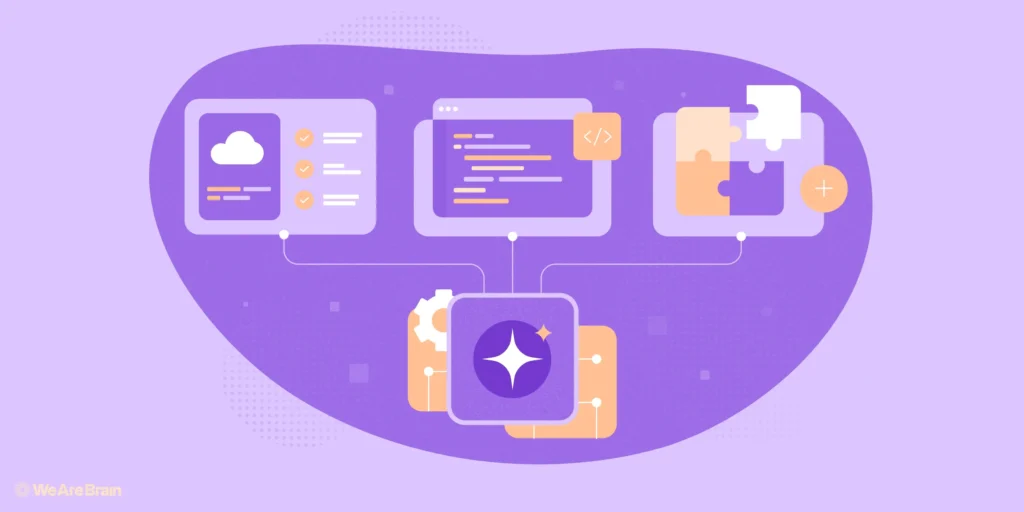
Enterprise AI software can be bought as a packaged platform, built as a bespoke system, or composed from open components assembled around your own data. This article compares the three approaches across time to value, data ownership, integration depth, lock-in and total cost, and sets out the five questions we use to guide the decision. It is written for technology and operations leaders about to commit budget to an AI capability.
In most of the cases the decision gets made too early. A vendor demo lands well, procurement starts, and the requirements are written afterwards to fit what was already chosen. A few months later the platform covers 60% of the workflow and the rest is handled by a spreadsheet.
Three routes are genuinely available, and each is right in different circumstances. Getting the choice right depends on understanding what each one actually costs you over five years rather than over the first quarter.
What counts as enterprise AI software?
Enterprise AI software is any system that applies machine learning or language models to a core business process at organisational scale, with the security, integration and governance requirements that scale implies. The definition excludes individual productivity tools, which follow completely different buying logic.
Three characteristics separate it from departmental AI tooling:
- It touches systems of record such as your ERP, CRM or data warehouse
- It processes data subject to regulatory obligations
- Its failures affect people outside the team that bought it.
Any system with those three properties deserves the full decision rather than a quick procurement.
Buy: packaged AI platforms
Buying means licensing a vendor platform that already does the job, configuring it to your process, and accepting the boundaries of what it supports. It is the fastest route to a working capability and the right choice when your process resembles everyone else’s.
The economics work when the workflow is standard. Reporting, business intelligence, document classification and customer service triage all have mature vendor options where building from scratch would be difficult to justify.
We rebuilt reporting for a leading player in the legal services sector this way, consolidating case management, billing and compliance data into a central Power BI environment on Azure SQL, with role-based dashboards for legal, finance and senior management. Reporting preparation dropped from days to hours and dashboard engagement rose by over 40%. Nothing about that outcome required a bespoke platform.
The limits show up at the edges. Packaged platforms constrain your data model, and the constraint compounds as more processes depend on it.
Build: bespoke AI solutions
Building means commissioning a system designed around your process, usually through an artificial intelligence software development company or an internal team. It is the right choice when the workflow is a source of competitive advantage and no vendor understands it.
The honest case for building is narrower than most vendors of bespoke AI solutions will tell you. It costs more up front, takes longer to reach production, and creates a maintenance obligation that outlives the people who commissioned it.
Where it earns its keep is scale and specificity. Our product locator for Maxeda DIY Group connects 17 million product-location combinations across more than 330 stores, integrated with SAP, with tooling that lets each store describe its own aisle layout in human terms. No packaged product models that problem, because no other retailer has it in quite that shape.
Compose: open components around your own data
Composing means assembling a system from open-source infrastructure, specialist services and your own integration layer, keeping the data and the orchestration under your control while buying capability where it is genuinely commoditised.
This is the approach we favour for most AI work, and it has become practical only recently. Open orchestration layers, open model weights and emerging integration standards such as the Model Context Protocol mean the assembly cost has fallen sharply.
A recent example: a major e-commerce brand in the Benelux needed to fix incomplete and inconsistent product data across a large catalogue. We composed the solution rather than building or buying wholesale, integrating a specialist enrichment platform through its API, preparing the catalogue for targeted fine-tuning, and building a unified internal interface where their team manages and approves enriched content. Time spent per item went from 20 minutes to 2, with roughly a 90% reduction in manual effort on titles and descriptions.
The specialist capability was bought. The data, the approval workflow and the integration remained theirs. Swapping the enrichment layer later is an engineering task rather than a migration.
| Buy | Build | Compose | |
|---|---|---|---|
| Time to first value | Weeks | Months | Weeks to months |
| Data ownership | Vendor data model | Complete | Complete |
| Integration depth | Limited to supported connectors | Unlimited | High, via open standards |
| Lock-in | High | Low, but tied to your own codebase | Low, components replaceable |
| Five-year cost | Recurring licences, rising with seats | High up front, then maintenance | Moderate, mixed licence and build |
| Best fit | Standard processes | Differentiating processes at scale | Most enterprise AI work |
Five questions we ask before the decision
We put these to leadership teams before any option is priced, because the answers usually make the choice obvious.
- Does this process differentiate us, or is it table stakes?
- What happens to our data model if this vendor changes their roadmap?
- Which parts of this are genuinely commoditised today?
- Who maintains this in three years, and do they exist yet?
- What is the cost of replacing it if we are wrong?
An option that is cheap to reverse deserves a lower burden of proof than one that is not.
Key takeaways
- Enterprise AI software touches systems of record, handles regulated data and affects people outside the buying team, which is what separates it from departmental tooling.
- Buying suits standard processes such as reporting and document classification, where a packaged platform reaches production in weeks.
- Building is justified when the process differentiates you and operates at a scale no vendor models, and it carries a maintenance obligation that outlives its sponsors.
- Composing keeps data and orchestration under your control while buying commoditised capability, and open integration standards have made it the practical default for most enterprise AI work.
- The cost of reversing a decision matters more than its up-front price, so weight reversibility heavily when the requirements are still uncertain.
Weighing up your options?
We help leadership teams make this decision with the five-year cost in view rather than the first-quarter one, and then deliver whichever route the answer points to. Talk to our enterprise technology team about where your requirements actually sit.
__________________________________________________________
The Groundwork Advantage
Between 60 and 95 per cent of enterprise AI initiatives produce no measurable business value. Our free AI handbook covers what has to be true inside an organisation before AI produces anything: clear business objectives, data you can trust, governance built in from the start, and infrastructure that keeps your options open.
Read the handbook | Take the five-question self-assessment
__________________________________________________________